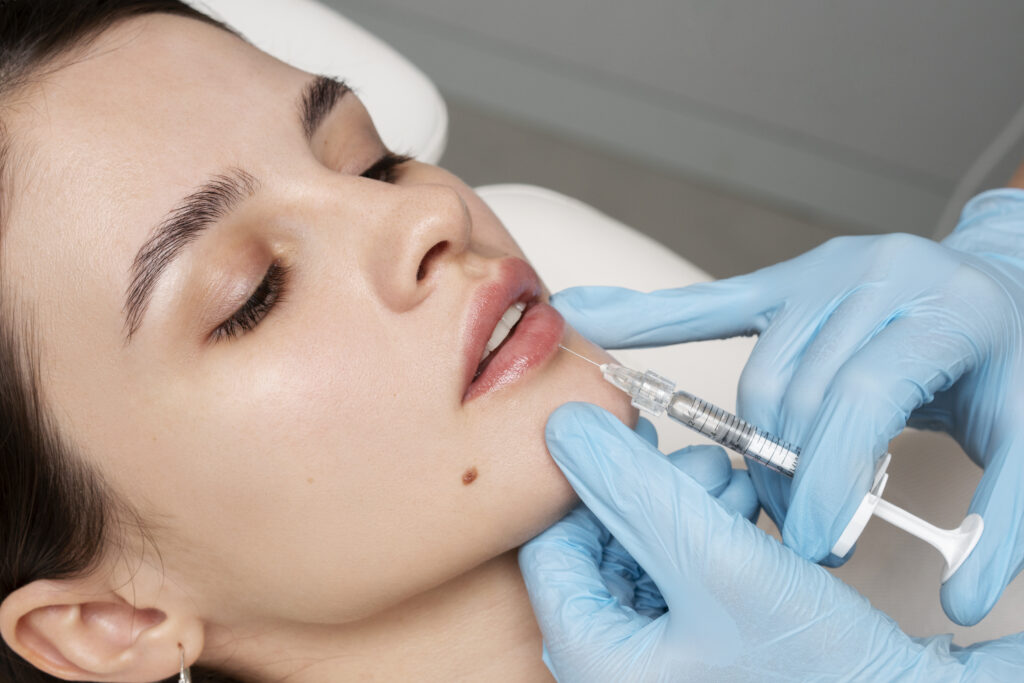
Dermal Fillers are injectable treatments used to restore volume, smooth lines, and enhance facial features. They are commonly used to treat wrinkles, sagging, and volume loss, especially in the cheeks, lips, and under-eye areas.
Types of Dermal Fillers:
Hyaluronic Acid Fillers (e.g., Juvederm, Restylane): These are the most common and temporary, lasting between 6 months to 2 years. They work by attracting water to the skin, adding volume and moisture.
Calcium Hydroxylapatite (e.g., Radiesse): This type of filler is used for deeper wrinkles and has a longer-lasting effect, typically lasting 1 to 2 years.
Poly-L-lactic Acid (e.g., Sculptra): This stimulates collagen production and is used to treat facial volume loss. The results are gradual and can last up to 2 years.
Polymethylmethacrylate (PMMA) (e.g., Bellafill): A more permanent option that is used for deeper lines and scars. It is typically used for more severe volume loss.
Benefits:
Non-surgical: Unlike facelifts or other surgical procedures, dermal fillers provide a non-invasive solution with little downtime.
Customizable: Fillers can be tailored to meet specific needs and can treat various facial areas like the cheeks, lips, and nasolabial folds.
Instant Results: Results are immediate, and the full effect is typically seen within a few days.
Common Treatment Areas:
Lips: To add volume and smooth out fine lines.
Cheeks: To restore youthful volume.
Under-eyes: To reduce dark circles and hollows.
Nasolabial Folds: The lines running from the nose to the corners of the mouth.
Chin and Jawline: To contour and add definition.
Side Effects:
Bruising and Swelling: Common post-treatment, typically lasting a few days.
Lumps and Bumps: These can form but generally smooth out with gentle massage.
Infection: Rare, but a risk associated with any injectable treatment.
Dermal fillers are often considered a safe, effective, and customizable option for people looking to refresh their appearance without going through surgery.
THE HIPPOCRATIC OATH
“I WILL PREVENT THE DISEASE WHENEVER I CAN, FOR PREVENTION IS PREFERABLE TO CURE.”